

Donald Trump has been dreaming of building a White House ballroom since before he entered politics, and in July 2025 he announced he would make it happen by the end of his second term. Details on this 90,000-square-foot addition were hazy, but the president assured everyone that it wouldn’t “interfere with the current building.” Two months later, the East Wing was pile of rubble.
Now the National Trust for Historic Preservation is suing to stop the project, arguing that it must undergo several legally mandated reviews and be authorized by Congress. U.S. District Judge Richard Leon agreed, ruling in March that all above-ground construction “must stop,” as no law “comes close” to giving Trump the legal authority to proceed without congressional authorization. But an appeals court ruled that construction can continue through at least June 5, when it will hear arguments on the case.
Here’s a guide to everything we know about the new White House ballroom, including updates on the plans, estimated cost, and why taxpayers may be on the hook for $1 billion, though Trump repeatedly said we wouldn’t pay a cent.
When did Trump announce he was building a ballroom?
Trump has been talking about a White House ballroom for decades. It became clear that this was more than just weird Trumpian musing in June 2025, when he revealed on Truth Social that he’d selected a site for the project:
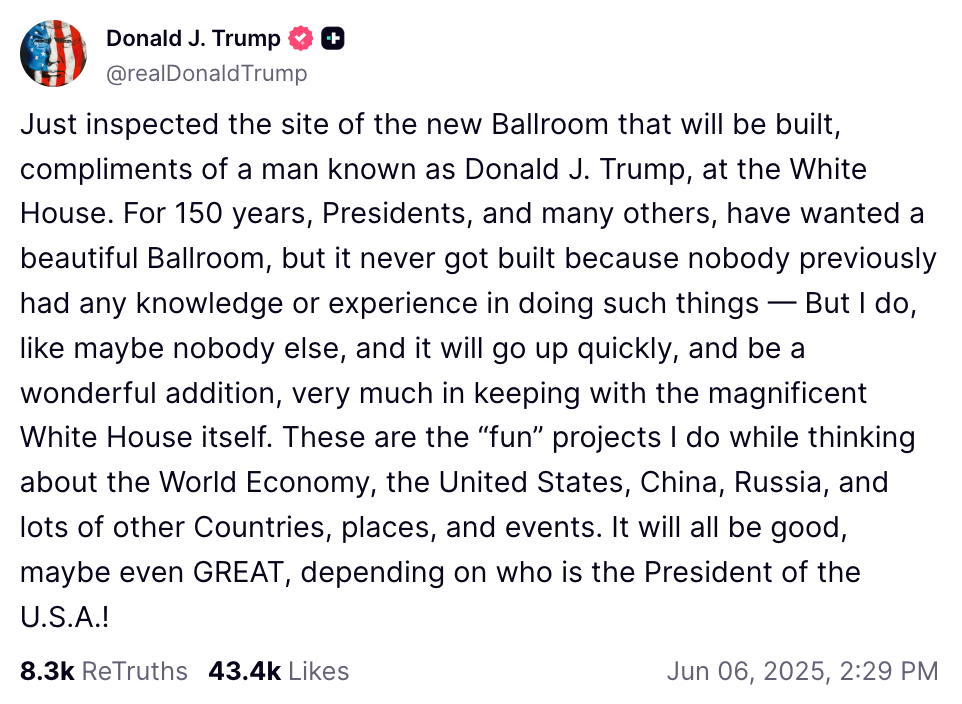
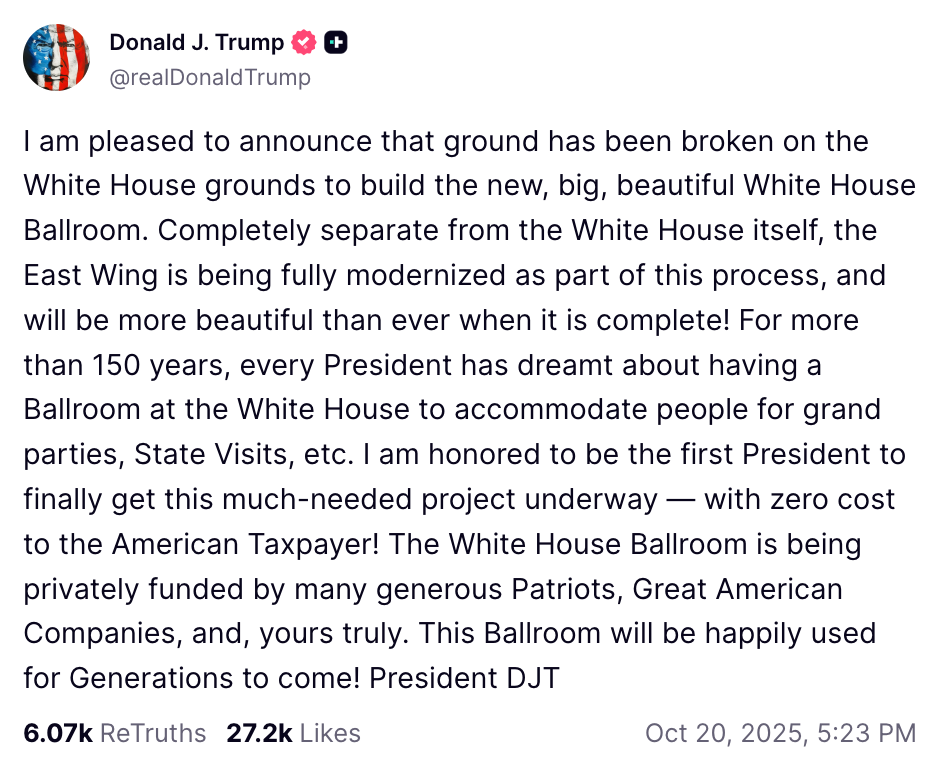
On July 31, 2025, White House press secretary Karoline Leavitt announced that construction of a 90,000-square-foot ballroom would begin “soon.”
When did demolition start?
Work began in mid-September 2025 with some tree removal. The White House said this landscape “preservation stage” might take weeks, and the Washington Post lamented, “Officials have not specified how many trees on the mansion’s grounds will be removed to make way for the new ballroom.”
It turns out reporters were missing the forest — or in this case the total destruction of a third of the White House — for the trees. The public learned the “preservation stage” had concluded when photos emerged of a backhoe ripping through the façade of the East Wing on October 20, 2025.
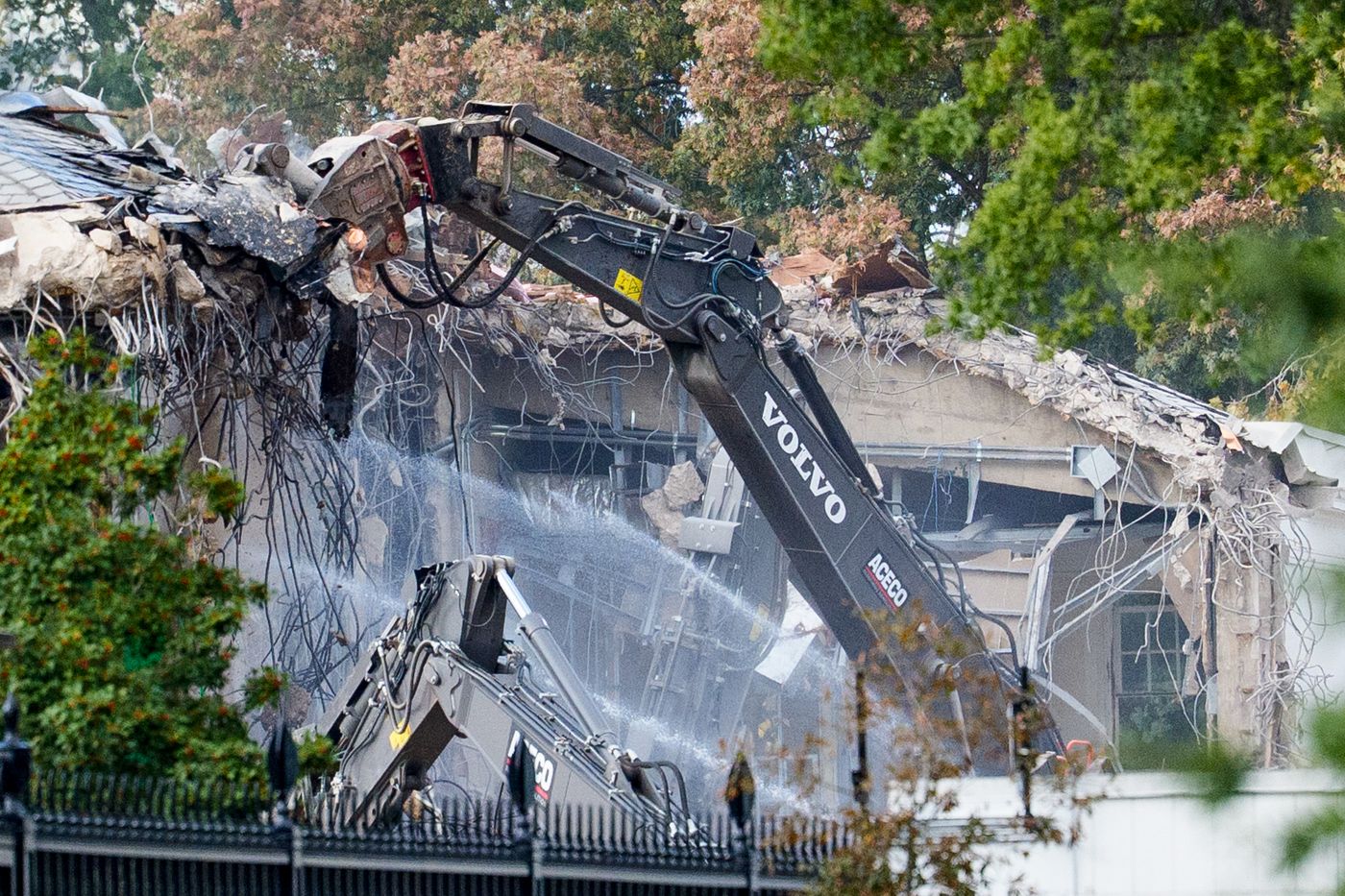
By October 23, the East Wing was just a pile of rubble:

Did Trump really say he wouldn’t demolish the East Wing?
From July to October 2025, Trump and other White House officials made contradictory claims about the fate of the East Wing.
The first White House press release on the ballroom said it would be located “where the small, heavily changed, and reconstructed East Wing currently sits.” In retrospect, that meant the entire East Wing was coming down.
But no one realized that at the time — partly because Trump explicitly said he wouldn’t damage the existing building. Just a few hours after the White House unveiled the ballroom plans, Trump said, “it won’t interfere with the current building,” adding, “It’ll be near it but not touching it — and pays total respect to the existing building, which I’m the biggest fan of.”
The fate of the East Wing remained shrouded in mystery even as construction vehicles were tearing into the building. The Treasury Department told employees, whose offices are next to the East Wing, not to share photos of the demolition. And it took days for a White House official to euphemistically confirm to ABC News that the “entirety of the East Wing will be modernized.”
National Park Service records released in December 2025 revealed that Trump and other White House officials knew the East Wing would be totally “deconstructed” at least two months before demolition began, per the Washington Post.
How did Trump defend the East Wing demolition?
As photos of the shocking destruction went viral, Trump told everyone to chill out because the East Wing was small and ugly anyway.
Why didn’t someone stop the destruction of the East Wing?
Trump has actually complained, nonsensically, that the National Trust for Historic Preservation should have filed its lawsuit before he bulldozed the East Wing with almost no public warning.
By law, the National Capital Planning Commission must vet even relatively minor construction and renovation projects at the White House. As the Washington Post reported, this process often takes years. So why didn’t the commission raise objections last summer? Well, conveniently for Trump, commission chair Will Scharf — one of his top aides, whom he appointed to lead the commission just before announcing the ballroom project — doesn’t think the board has jurisdiction over demolition or site preparation work on federal property.
“What we deal with is essentially construction, vertical build,” Scharf said at the September 2025 meeting of the National Capital Planning Commission.
What’s going on with the lawsuit?
The National Trust for Historic Preservation, a nonprofit group chartered by Congress to preserve historical buildings, sued the Trump administration in December, asking the judge to pause ballroom construction until the project goes through legally required reviews and is authorized by Congress.
Justice Department lawyers have argued all along that the project can’t be paused, citing national security concerns. (The White House’s bombproof bunker, known formally as the Presidential Emergency Operations Center, is located under the East Wing.) Immediately after the the assassination attempt at the White House Correspondents Dinner, Trump and other Republicans began making the case that the incident shows the ballroom must be completed as quickly as possible.

(This doesn’t make really sense, as the annual event is hosted by the press, not the White House, and the planned ballroom wouldn’t hold the dinner’s 2,600 guests anyway.)
U.S. District Judge Richard Leon initially declined to halt construction in a February 26, 2026 ruling, citing procedural issues. Trump immediately celebrated on Truth Social, but he’d misunderstood the ruling. Judge Leon invited the National Trust to revise its claim to focus more on the president’s power to make sweeping changes to the White House. The Trust amended its suit, and on March 31, 2026, Judge Leon ordered a halt to the construction, writing, “no statute comes close to giving the President the authority he claims to have.” He later clarified that work could continue on below-ground facilities, but warned “national security is not a blank check to proceed with otherwise unlawful activity.”
The Trump administration quickly appealed. The U.S. Court of Appeals for the D.C. Circuit stayed Judge Leon’s ruling, allowing construction to continue through at least June 5, when it will consider the case. (Justice Department officials also asked Judge Leon to change his order after the WHCA shooting, but he probably won’t be moved by their rambling Truth Social-esque legal filing.) The judge has said he expects the case to be appealed no matter how he rules, possibly going to the U.S. Supreme Court.
What’s in the bunker under the ballroom?
For many years Trump has said the White House needs a ballroom mainly for hospitality reasons. But as the National Trust’s lawsuit unfolded, Trump began framing it more as a security necessity.
In March, Trump told reporters that the military was building a “massive” underground complex, describing his beloved ballroom as “essentially … a shed for what’s being built under.”
The original White House bunker was constructed under the East Wing during World War II. The DOJ has shared a surprising amount of information about how it’s being revamped.
“Together, the ballroom and secure facilities throughout the Project—including bomb shelters, a state-of-the-art hospital and medical facilities, military installations, and more—form a single integrated, complex unit that is vital for the national security of the United States,” the DOJ told the U.S. Court of Appeals for the District of Columbia Circuit.
Would Congress Trump’s ballroom?
Trump is hoping he’ll win the appeal so he won’t have to. He keeps insisting that he does not need congressional authorization, and has made no attempt to secure it.

Lawmakers told the Post that they expect any ballroom authorization legislation would spark a fight in Congress, as the project is very unpopular with the public.
Who owns the White House?
We do. The White House and the surrounding grounds officially became a national park in 1961. “The White House is owned by the American people and stewarded by the National Park Service,” according to NPS.gov.
Judge Leon noted this fact in his March ruling, writing, “The President of the United States is the steward of the White House for future generations of First Families. He is not, however, the owner!”
Have plans for the ballroom been approved?
In late December 2026, months after the destruction of the East Wing, the Trump administration formally submitted application to two committees required to to review federal construction: the National Capital Planning Commission and the Commission of Fine Arts. Since returning to office, Trump has packed both committees with his allies. (For example, the Fine Arts panel now includes Trump’s 26-year-old deputy director of Oval Office operations, but no landscape architects. And the ostensibly independent National Capital Planning Commission softened the language on its authority over the ballroom project at the White House’s request.)
The White House said it planned to complete the approval process by early March 2026, which is an unbelievably fast timeline for for a federal project of this size. The Commission of Fine Arts gave the project its final approval on February 19, 2026.
The National Capital Planning Commission was expected to approve both the preliminary and final site and building plans for the ballroom at its March 5, 2026 meeting. But the vote was delayed at the last minute due to a deluge of mostly negative public responses. The committee received more than 35,000 written comments and more than 104 requests to testify.
Who is the architect on the ballroom project?
The project was initially helmed by McCrery Architects. But architect James McCrery II reportedly disagreed with President Trump on the ever-increasing size of the ballroom. By early December, McCrery had been replaced by architect Shalom Baranes, as the Washington Post reported:
Baranes’s firm has handled a number of large Washington projects dating back decades, including projects involving the main Treasury building near the White House, the Federal Reserve and the headquarters of the General Services Administration.
Baranes led a $1 billion renovation of the Pentagon immediately after the terrorist attacks of Sept. 11, 2001, which he described as his “proudest moment” in a 2017 Washington Post op-ed. His architectural approach, which includes modernist buildings, is different from McCrery’s classical style.
Are there renderings of the new ballroom?
Sort of; shortly after Leavitt’s July 2025 announcement, the White House posted eleven artist renderings of what the new event space would look like from various angles. But the finished product might look nothing like this, since the design has changed multiple times since these images were released.
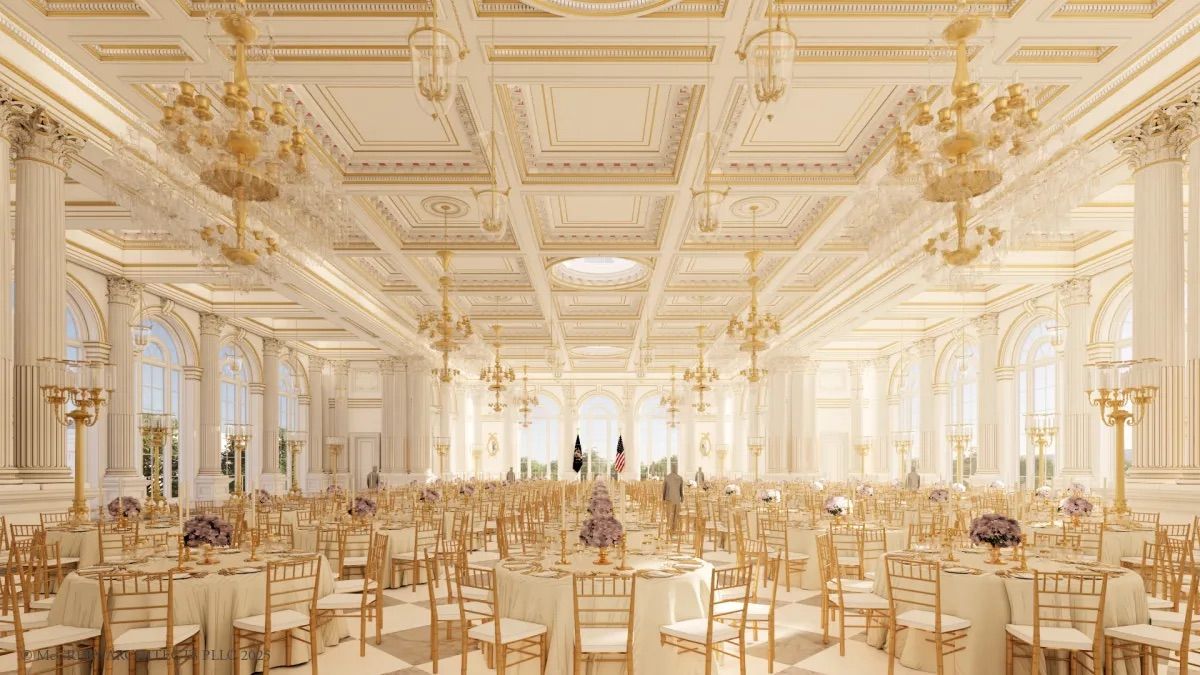



Trump posted a different rendering to Truth Social on February 2, 2026:

And in March he interrupted his own Iran war briefing to show off a new batch of renderings, seemingly in response to the New York Times criticizing the old design:
While the plans remain in flux, Trump seems to have a clear picture in his mind.
How big will the ballroom be?
The White House initially said it would seat 650 people, but Trump kep throwing out higher and higher numbers, claiming at one point in the fall of 2025 that it would seat about 1,000 people. (The East Room, currently the largest room in the White House, can only seat 200.)
Photos of the president showing off models of the project to his grandchildren, which were shared by Lara Trump, show that the new ballroom will dwarf the White House:
Last summer a National Parks Service official said the new building would be 55 feet tall. But in a January 2026 presentation to the National Capital Planning Commission, architect Shalom Baranes said it will be 60 feet high on its north side and 70 feet high on its south side. That would make the ballroom as tall as the White House’s main mansion, which “breaks with long-standing architectural norms requiring additions to be shorter than the main building,” according to the Post.
Baranes’s presentation contained some other surprises:
Baranes told the panel that the White House had abandoned plans to make the ballroom larger. But he said officials are now considering a one-story addition to the West Wing’s colonnade to create symmetry with the planned two-story colonnade that would lead from the White House to the ballroom building. Other features presented Thursday include an office suite for the first lady, a commercial kitchen and a rebuilt White House movie theater.
What is Trump doing to the West Wing?
He’s looking into building another story on top of the colonnade that connects the West Wing to the residence. Trump first shared this plan with the New York Times in January 2026, referring to it as the “Upper West Wing.”
A day later, architect Shalom Baranes mentioned the addition during his NCPC presentation, saying it may be needed “reinstate symmetry along the central pavilion of the White House.”
How much will the ballroom cost?
Initially the White House said it would cost approximately $200 million, but that number keeps getting larger, too. In mid-October, Trump told reporters he’d raised “more than $350 million” for the project. In a January 2026 Truth Social post, the president put the cost at “300 to 400 Million Dollars (depending on the scope and quality of interior finishes!)”
Is Trump for the White House ballroom?
While ranting about a White House ballroom over the years, Trump always made it sound like he’d pay for it on his own. But Leavitt said in her initial annoucement, “President Trump and other patriot donors have generously committed to donating the funds necessary to build this approximately $200 million structure.”
The White House declined to give details on what Trump would pay versus how much would be covered by these “other patriot donors.”
So far the only Trump contribution we know of is the $24.5 million YouTube paid to settle a lawsuit he brought after the site suspended his account following the Capitol riot. Court documents said the money would go to the Trust for the National Mall and the ballroom project.
Will any taxpayer money be used to fund the ballroom?
While Trump and other White House officials repeatedly said that the ballroom won’t “cost taxpayers a dime,” the latest Republican reconciliation bill includes $1 billion in public funding for “security adjustments and upgrades” to the East Wing Modernization Project (the official name for the ballroom). Technically, this money would go to the Secret Service and could not be used for “non-security elements” of the ballroom. But since Trump has argued the whole project is about national security, it’s unclear if that will be a meaningful limitation.
Republicans are looking to pass this reconciliation bill, which doesn’t require any Democratic votes, before the midterms. But Punchbowl reported that they may strip out the ballroom funding, as members know it’s politically toxic. “A first-year poli sci major would know not to ask members to take this vote and we hope the Speaker does too,” said one House Republican.
Who’s donated to the ballroom so far?
Amid the furor over the leveling of the East Wing in late October, the White House released a list of 37 corporations and individuals that have donated to the project:
• Altria Group, Inc.
• Amazon
• Apple
• Booz Allen Hamilton
• Caterpillar, Inc.
• Coinbase
• Comcast Corporation
• J. Pepe and Emilia Fanjul
• Hard Rock International
• HP Inc.
• Lockheed Martin
• Meta Platforms
• Micron Technology
• Microsoft
• NextEra Energy, Inc.
• Palantir Technologies Inc.
• Ripple
• Reynolds American
• T-Mobile
• Tether America
• Union Pacific Railroad
• Adelson Family Foundation
• Stefan E. Brodie
• Betty Wold Johnson Foundation
• Charles and Marissa Cascarilla
• Edward and Shari Glazer
• Oil billionaire Harold Hamm
• Benjamin Leon Jr.
• The Lutnick Family
• The Laura & Isaac Perlmutter Foundation
• Blackstone Chief Executive Stephen A. Schwarzman
• Konstantin Sokolov
• Kelly Loeffler and Jeff Sprecher
• Paolo Tiramani
• Cameron Winklevoss
• Tyler Winklevoss
The list did not say how much each donor contributed. In September 2025, CBS News reported that multiple companies had already pledged to donate $5 million or more to the project. In October, Trump hosted a dinner for ballroom donors at the White House.
Trump is also taking non-monetary donations. The White House “secured tens of millions of dollars worth of donated foreign steel” from ArcelorMittal, according to the New York Times. Days after Trump said he’d been promised a steel donation worth $37 million last fall, the White House made tariff adjustments that could benefit the Luxembourg-based firm.
Are there any other secret ballroom donors?
Probably! The Trump administration tried to block the release of the ballroom-fundraising contract between the White House, the National Park Service, and the Trust for the National Mall. But Public Citizen, a government-watchdog organization, successfully sued to obtain the agreement.
The contract, which was published by the Washington Post in April, includes provisions shielding donors’ identities and avoiding conflict-of-interest reviews. Many of the ballroom donors that have chosen to publicly identify themselves — including Amazon, Lockheed Martin, Palantir, and Google — have billions of dollars in contracts with the federal government. But these provisions mean we have no way of knowing if there are donors with even more egregious conflicts of interest.
Doesn’t this raise major ethical issues?
Absolutely. Noah Bookbinder, the president of Citizens for Responsibility and Ethics in Washington, or CREW, told the New York Times last fall that the plan to rely on private donors is “highly unusual” and there’s a risk that they “could see it as a way to curry favor with the administration.”
Ethics watchdogs also noted that Trump publicly hosting the donors at the White house puts pressure on other companies to contribute.
“Every company that is invited to that dinner that either doesn’t show or doesn’t give knows now they will be out of favor with the Trump administration,” said Claire Finkelstein, a University of Pennsylvania law professor and faculty director of the Center for Ethics and the Rule of Law, told the Journal.
What do ballroom donors receive?
Aside from potentially currying favor with the administration, they may get their name displayed on the building. But as of September 2025 that had yet to be decided, as CBS News reported:
The pledge form, which was reviewed by CBS News, gives donors the option to pay in a lump sum or spread their contribution over three installments to be completed by 2027.
In return, donors are eligible for “recognition associated with the White House Ballroom.” What form that recognition takes is still being discussed, but several sources said the expectation is that names will be etched in the ballroom’s brick or stone.
They’ll also get a big tax write-off:
Meredith O’Rourke, a top political fundraiser for Mr. Trump, is leading the effort, paired with the Trust for the National Mall, an organization that supports the National Park Service. The trust’s nonprofit status means donations come with a federal tax write-off.
What happened to the East Wing offices?
They were temporarily relocated, but the ultimate fate of these offices remains unknown. Anita McBride, former chief of staff to First Lady Laura Bush, raised concerns about how the loss of the East Wing would impact the daily functioning of the White House.
“Betty Ford always called the East Wing the ‘heart’ of the White House,” McBride told the Hill. “All the business and policy gets done in the West Wing, that’s critically important. But the heart of the White House is the East Wing. And so what, what will be the new East Wing?”
What happened to the contents of the East Wing?
For two months after the leveling of the East Wing, it was unclear what happened to everything inside the building. But National Park Service records from August 2025, which outlined the preservation process, were eventually made public during the legal battle over the ballroom. The Washington Post reported:
They detailed how Park Service crews would document, remove and preserve fabrics, furniture, building materials and the Kennedy Garden arbor before demolition began. The Park Service also said it would take high-resolution digital photographs of the East Wing and use scanning equipment to create a 3D model of the building.
The president has showed off a bust of former President Abraham Lincoln, which he said he salvaged from the East Wing. In a video Kai Trump, the First Granddaughter, posted to YouTube in December, the president pointed to the bust in the West Wing colonnade and said, “This came out of the East Wing, the famous East Wing. This looks good, doesn’t it, here?”
As for the actual building, debris from the East Wing demolition was dumped on a public golf course in Washington. Soil at the location recently tested positive for lead, chromium and other toxic metals, according to National Park Service data.
What do the former First Ladies think about the ballroom?
They don’t love it! Hillary Clinton decried the East Wing demolition on social media as it was happening. Former First Daughters, Chelsea Clinton, Patti Davis, and even the usually apolitical Jenna Bush Hager have all lamented the loss of the East Wing as well.
Michelle Obama spoke out against the ballroom repeatedly while on her fall book tour.
“It makes me confused,” she said on The Late Show. “I am confused by what are our norms? What are our standards? What are our traditions? I just feel like what is important to us as a nation anymore, because I’m lost. There were a whole standard of norms and rules that we followed to a T that we painstakingly tried to uphold, because it was bigger than us … that East Wing … it’s not mine. It is ours.”
What is Melania Trump’s ballroom stance?
She may not be a fan either. The Wall Street Journal reported that she “privately raised concerns about tearing down the East Wing and told associates it wasn’t her project, according to administration officials.”
How long has Trump been planning this ballroom?
For many years, Trump has publicly claimed that he offered to build a collapsible $100 million White House ballroom and the Obama administration did not take him up on it:
Surprisingly, this is at least partially true. In his book Believer: My Forty Years in Politics, David Axelrod confirmed that while he was working in the Obama White House in 2010, Trump called to pitch him on a ballroom. (Trump claims he offered to pay for it himself, but Axelrod did not address that detail.)
“‘I build ballrooms. Beautiful ballrooms,’” Trump said, according to Axelrod. “Not being much of a dancer, I didn’t know where he was headed. ‘I see you have these state dinners on the lawn there in these shitty little tents. Let me build you a ballroom you can assemble and take apart. Trust me. It’ll look great.’”
Axelrod said he handed the pitch off to someone else, and they didn’t follow up.
When will the ballroom be finished?
The press release says it’s “expected to be completed long before the end of President Trump’s term” in January 2029. Trump has claimed the project is “ahead of schedule” but we don’t really know what that means.
Will the ballroom be named after Trump?
The president denied that the ballroom will be named after him while speaking with reporters in October 2025.
“I don’t have any plan to call it after myself,” Trump said. “That was fake news. Probably going to call it the ‘presidential ballroom’ or something like that. We haven’t really thought about a name yet.”
However, potential donors received a pledge agreement that refers to “The Donald J. Trump Ballroom at the White House,” according to CBS News. Senior administration officials told ABC News that the name will probably stick. And that seems even more likely after the attempted renaming of the “Trump-Kennedy Center.”
Is this project really necessary?
President Trump and White House officials have described the ballroom as a “much-needed” addition to the White House from the very start.
Since the East Room, the largest room in White House, can only seat 200 people, state dinners usually take place in a tent on the lawn. Back in 2011, Trump lamented that the White House is using “an old, rotten tent that frankly they probably rented, pay a guy millions of dollars for it even though it’s worth about $2?” But as Eater noted, it’s actually a pretty swanky tent:
The tent for the 2009 India dinner, which Vanity Fair described as “a massive pavilion, complete with an orchestra platform, theatrical lighting, a professional sound system, full heating, satellite kitchens, and a dozen chandeliers bedecked with sustainably harvested magnolia branches and ivy,” took six days to construct and cost a reported $85,000.
And the symbolism of this new project is “monstrous,” as New York’s Chris Bonanos pointed out: “That Trump will build a ballroom — the most on-the-nose embodiment of let-them-eat-cake Versailles extravagance — just as he throws old people off Medicare and kids off food stamps is as big a trolling as has ever been trolled.”
So it certainly makes sense that Trump is now trying to present the project as a much-needed White House security upgrade.
So why is Trump really building this ballroom?
Is Trump doing this because he’s a magnanimous builder who wants to share his gift with the American people? Or is he just a narcissist looking to leave his mark on the White House by transforming it into Mar-a-Lago North? That’s a matter of interpretation. But it’s pretty clear that he really, really hates partying in a tent.
This post has been updated throughout.
More on Politics
- The Costs of Trump’s Resurgent Iran War Are Rising Fast
- Johnson Promises Hawks Huge Safety-Net Cuts … Next Time
- Katie Porter Is Pivoting From Politics to Bookstagram


