Archive for the ‘Copper’ Category

Over 500 types of high-quality mineral reserves in North Korea

Thursday, March 3rd, 2016

Institute for Far Eastern Studies (IFES)

North Korean website DPRK Today recently lauded the copious amounts of over 500 types of quality mineral reserves in North Korea including iron ore, anthracite, bituminous coal, gold, silver, and copper. This news appeared amidst the discussions about expanding international sanctions on North Korea’s mineral exports after the fourth nuclear test.

An article titled “Choson from the Geological Perspective,” written by Dr. Choe Won Jong, researcher at the Institute of Geology of the National Academy of Sciences, was posted on the DPRK Today website on February 18.

According to Dr. Choe, North Korea has rich mineral reserves with over 500 types of minerals including billions of tons of iron ore, coal, bituminous coal, silver, copper, lead, zinc, tungsten, magnesite, graphite, and limestone. Reportedly six rare minerals including holdongsok, suansok, and sangpaldongsok were first detected in North Korea and aptly named after the regions where the discoveries were made.

Dr. Choe commented, “The reason that the Republic [DPRK] has a wealth of natural resources is likely to be influenced by the long history and diversity of crustal movement over time. . . . the earth of our country has a long history of more than 3.6 billion years.”

It was said that most of the graphite deposits were formed about 2.5 billion years ago and Ryongyang and Taehung magnesite deposits, Komdok lead-zinc deposits, and Tanchon-Hochon region non-ferrous metal deposits were formed 2 billion years ago. It reported that there are high quality diatomite deposits in Taehongdan County, formed when the pumice of Mount Paektu erupted about 1,000 years ago.

According to Choe, in geological terms, these underground resources were formed as the crust structure of the Korean peninsula is positioned in the eastern outskirts of the Eurasian continental crust as it abuts against the Pacific oceanic crust in the west.

He further explained that there were at least ten big crustal movements surrounding the Korean peninsula, and over 16 periods of magmatism that occurred in North Korea which led to massive granite formation over the years and at this occurrence, non-ferrous metals such as gold, copper, tungsten, and molybdenum, as well as rare metals and rare earth metal deposits were formed.

Non-metallic deposits and copper, iron metal deposits such as graphite, muscovite, feldspar were formed during over seven periods of metamorphism, which reportedly also improved the quality of already existing iron ore and magnesite deposits. From the northeast region that stretches from Mount Paektu to Kilju-gun, all the way to Pukchong-gun to Samsu-gun in the northwest of Machonryong Range, a famous deposit formation region can be found that is said to be rich in magnesite, lead, zinc, copper, gold, iron, and other minerals.

Dr. Choe boasted, “Truly, Machonryong Range can be seen as a great treasure chest in the Korean peninsula . . . . our country has become more and more abundant in underground resources as we are surrounded by the sea on three sides. However, gems must be polished to shine,” and thus he emphasized the need for the development and utilization of these resources.

Share

Russia offers electricity for copper

Wednesday, May 6th, 2015

According to RBTH:

North Korea has offered to allow Russian participation in the development of the Onsong copper deposit, in exchange for Russia providing electricity to the entire east coast of the country.

“The Korean side proposed that Russia consider supplying electricity to the areas of Rason, Chongjin and Tanchon as well as the Wonsan-Mount Kumgang international tourism zone, with the costs of electricity supply covered with copper ore from the Onsong deposit in North Hamgyong Province,” the Ministry for the Development of the Russian Far East said in a press release.

The press note, which summed up the results of the meeting of the Russia-North Korea intergovernmental commission that was held in Pyongyang in late April, did not specify which companies would be involved in the project.

Russia and North Korea are expected to create a special working group to study the feasibility of electricity supply to the Korean peninsula. North Korea is one of the most power deficient countries in Asia with cuts in supply and load shedding being a regular occurrence even in Pyongyang.

Read the full story here:
North Korea offers Russia copper ore in exchange for electricity
RBTH
2105-5-6

Share

DPRK mineral exports to China increase

Sunday, November 6th, 2011

UPDATE 1 (2014-1-21): See more recent data here and here.

ORIGINAL POST (2011-11-6): According to Yonhap:

North Korea’s mineral exports to China have tripled this year compared to a year ago, a study showed Sunday.

A joint study of Chinese data by Yonhap News Agency and Seoul-based IBK Economic Research Institute showed that China imported 8.42 million tons of minerals from North Korea from January to September this year, worth US$852 million.

Over the first nine months of last year, China brought in 3.04 million tons of minerals from the North for $245 million.

Most of the minerals were anthracite coals, the data showed. This year, of 8.42 million tons, 8.19 tons were anthracites.

China is the sole major ally and the biggest economic benefactor for North Korea, a reclusive regime under international economic sanctions following its nuclear and long-range missile tests.

Cho Bong-hyun, an analyst at the IBK institute, said North Korea may be trying to earn much-needed hard currency as it aims to become a powerful and prosperous country by 2012.

“Last year, North Korea ordered its institutions to meet their goals in foreign currency income by this year,” Cho said. “Since exporting minerals is a military business, we can see that the military is trying to meet its target. In addition, the steep mineral export growth was attributable to the lifting of the cap on the amount of mineral exports, as ordered by North Korean leader Kim Jong-il.”

China appears to be trying to stockpile mineral resources at affordable prices, Cho added. North Korean anthracites were traded at an average of $101 per ton, whereas the international standard for quality anthracites is $200 per ton.

“Given that North Korean coals are of very good quality, trade with China must have been made at a fairly low price,” Cho said.

Meanwhile, sources said North Korean authorities last month entirely halted its coal exports, as the impoverished country fears a shortage of energy resources during the upcoming winter.

From January to September this year, China exported 732,000 tons of minerals to North Korea, most of them crude oil.

Here is the IBK web page.  If anyone can find a copy of this report and send it to me to post, I would appreciate it.

Additional information:
1. The economics lessons: A. The more isolated the DPRK’s economy from the global trade and financial system, the greater monopsony power Chinese firms can exert on their North Korean trading partners. B. The rents earned in the current DPRK-China trade regime are visible and have organized constituencies.  Unfortunately the much greater gains that could be reaped if the North Korean economy was more open, integrated, and dynamic remain unseen and their potential beneficiaries remain unknown and unorganized.

2. The Nautilus Institute published a very interesting paper by Nathaniel Aden on China DPRK trade back in June. See it here.

3.  Here is the most recent US Geological Survey report on the DPRK’s mineral sector.

Read the Yonhap story here:
N. Korea’s mineral exports to China tripled from last year: study
Yonhap
2011-11-6

Share

Chinese joint venture company takes over Hyesan Youth Copper Mine

Monday, September 19th, 2011

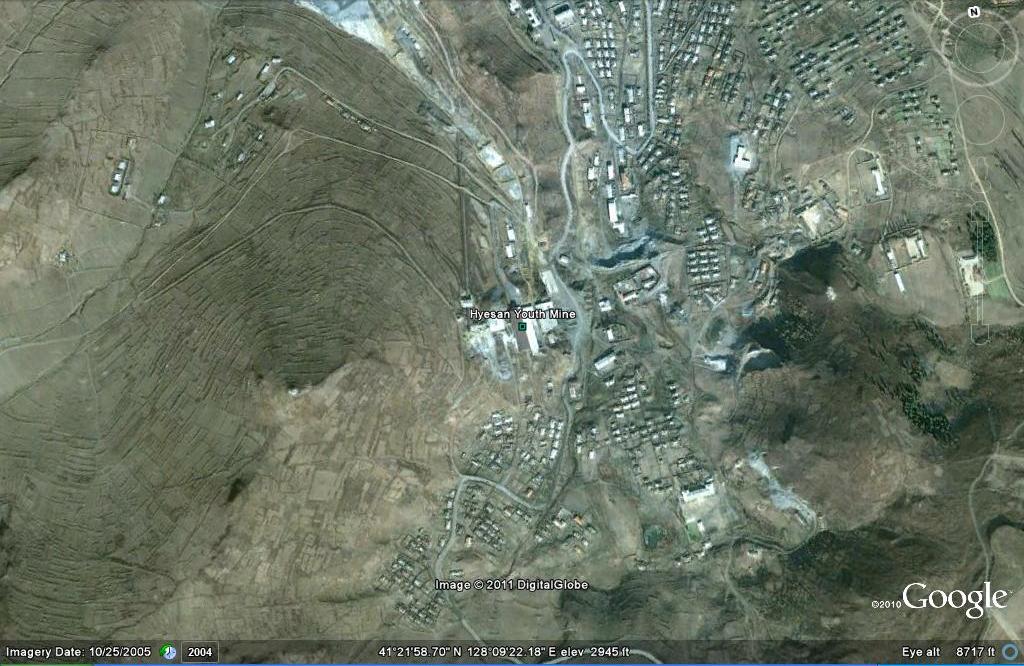
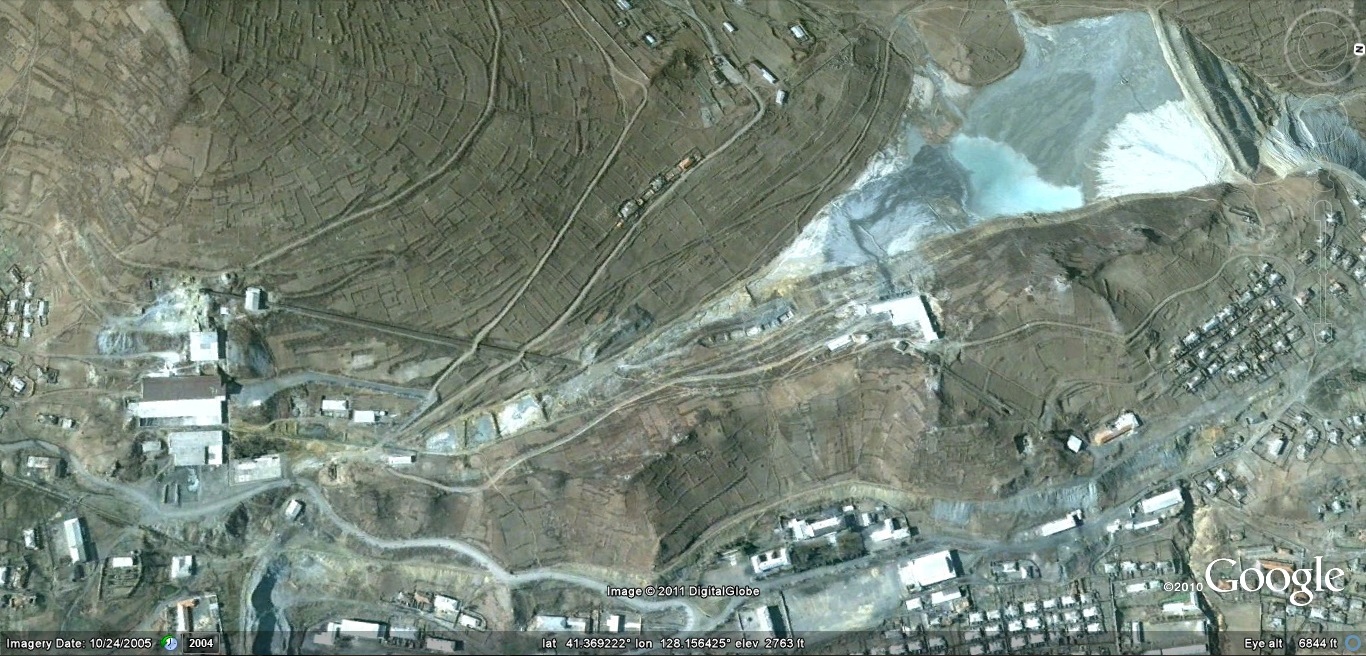
Pictured above (Google Earth): Hyesan Youth Copper Mine.  See in Google Maps here.

According to Xinhua (China):

Hyesan-China Joint Venture Mineral Company, a large joint project between China and the Democratic People’s Republic of Korea (DPRK), started operation at Hyesan of Ryanggang province on Monday.

The mineral company was jointly set up by Wanxiang Resources Limited Company of China and the Ministry of Mining Industries of the DPRK on Nov. 1, 2007. Its main business was to produce and sell copper.

DPRK Mining Industries Minister Kang Min Chol and Chinese ambassador Liu Hongcai attended the opening ceremony.

Kim Chol, chairman of the people’s committee of the Ryanggang province, said at the ceremony that the joint venture was one of the symbols of the development of the DPRK-China friendship and would be a model of modernization, science and economic benefits.

Liu believed the company would make profits for both sides, benefit the two peoples and promote traditional China-DPRK friendship.

According to Reuters:

The mine was located a few miles from the Chinese city of Changbai in the northeastern province of Jilin and was 51 percent owned by Wanxiang, a source with direct knowledge of the project told Reuters on Tuesday.

The mine had a designed annual capacity of 50,000-70,000 tonnes of copper concentrate, expected to contain 20-30 percent copper, he added.

“All the concentrate will be sold to China,” the source said.

The source said the joint venture would conduct second-phase construction to expand the capacity of the mine if production ran smoothly, but did not give details on timing or expanded capacity.

China is the world’s top copper consumer but does not produce sufficient concentrate to meet demand. The country imported 3.4 million tonnes of copper concentrate in the first seven months of 2011, down 11 percent from a year earlier.

According to KCNA:

The Hyesan Youth Mine in Ryanggang Province was successfully updated as required by the new century.

The workers and technicians of the mine together with Chinese technicians and skilled workers completed the vast modernization project and successively ensured their commissioning.

The modernization of various production processes including mining, carriage and ore dressing made it possible to boost mineral production and thus contribute to economic development and the improvement of the standard of people’s living.

A ceremony for the completion of the modernization project at the Hyesan Youth Mine and the Hyesan-China Joint Venture Mineral Company was held on Monday.

Present there were Kang Min Chol, minister of Mining Industry, Kim Hi Thaek and officials concerned, Liu Hongcai, Chinese ambassador to the DPRK, and staff members of his embassy and Han Youhong, president of the Wanxiang Resources Co., Ltd. of China, and personages concerned.

Ri Mun Yong, manager of the Ryanggang Provincial Mining Complex, made an address to be followed by congratulatory and other speeches.

At the end of the ceremony, the participants went round production processes.

That day a reception was given in connection with the ceremony.

Although foreign investors and aid groups frequently build/ repair / upgrade North Korea’s state owned enterprises, it is rare that they are given any credit for their work in the official media.

Previous posts about the Hyesan Mine:
1. Poor electricity supply (2011-5-16)

3. Mine is flooded (2007-11-1)

4. China investing in mine (2007-4-12)

5. Chinese investing in mine (2006-12-24)

Additional mining information:
1. DPRK – China minerals for food program (2011-8-19)

2. DPRK looking to export rare earths (2011-7-23)

3. DPRK – China trade: 1995 – 2009 (2011-6-7)

4. Increase in DPRK’s mineral resources exports to China expected again for this year (2011-2-28)

5. DPRK – China mining deal (2011-2-6)

6. China expanding mining rights in DPRK (2010-1-15)

Share

The mining industry of the DPRK

Sunday, August 7th, 2011

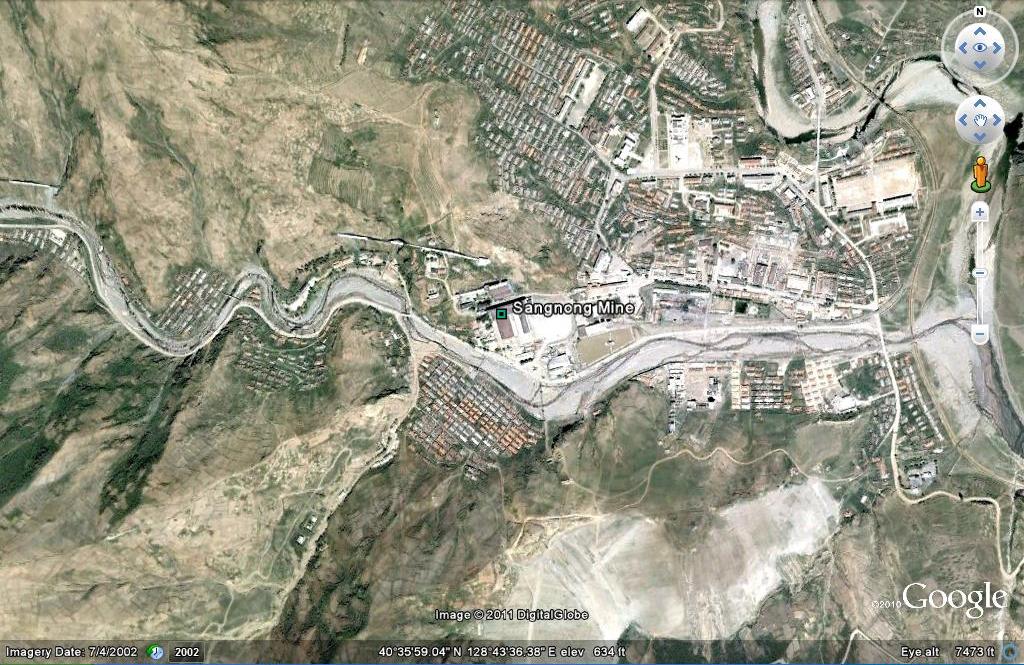
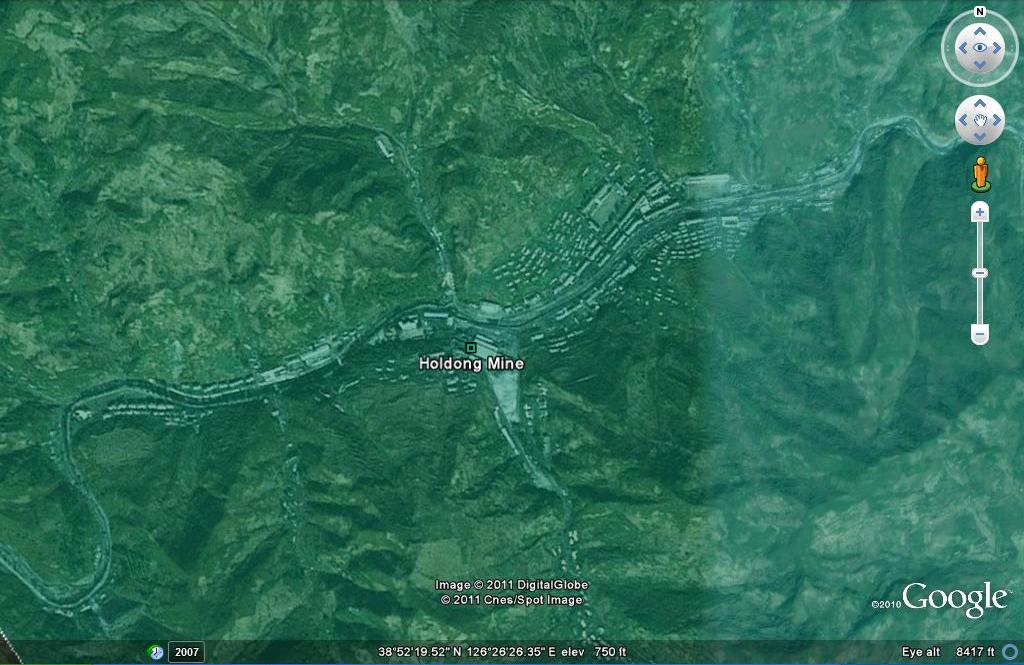
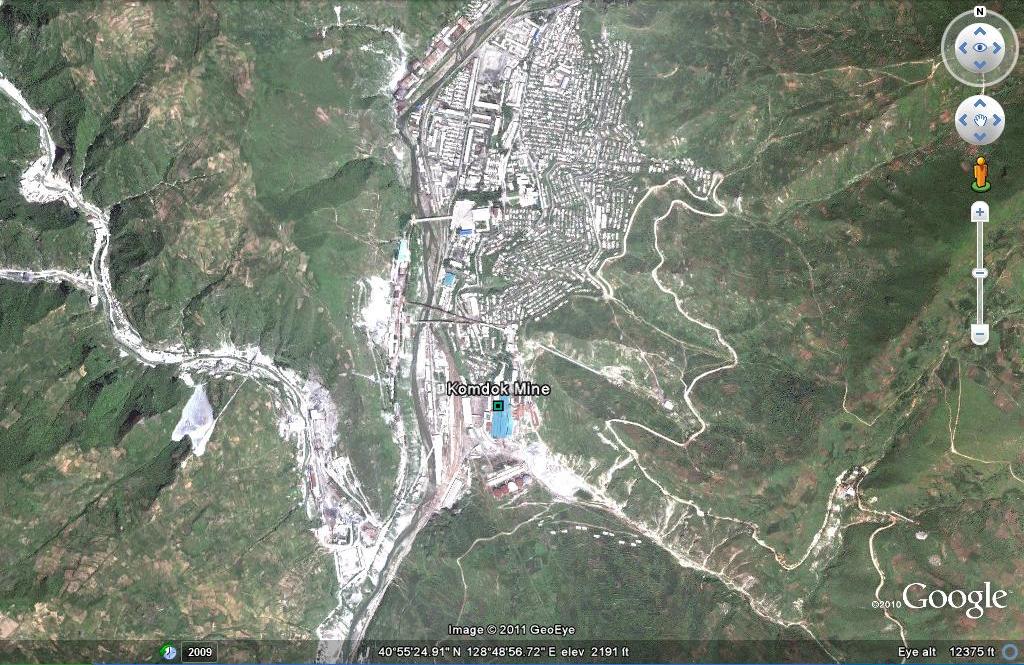
Last week the Nautilus Institute posted a paper on the DPRK mining industry written by Choi Kyung-soo.  You can see the full report here.  A couple of the mine locations were incorrectly reported, so I thought I would correct the record (as I understand it), as well as offer coordinates and satellite imagery of all the facilities mentioned in the paper:

Sangnong Mine (상농광산)
40°36’0.38″N, 128°43’35.40″E
Sangnong Worker’s District, Hochon County, South Hamgyong Province. According to the paper, the mine is located in the “Dancheon district of Hamgyeongnam-do”.

Holdong Mine (홀동광산)
38°52’18.15″N, 126°26’21.98″E
Holdong Worker’s District, Yonsan County, North Hwanghae

Hyesan Youth Mine (해산청년광산)
41°21’52.36″N, 128° 9’28.35″E
Hyesan City, Ryanggang Province

Komdok (Geumdeok) Mine (검덕광산)
40°55’9.41″N, 128°49’13.76″E
Kumgol-dong, Tanchon, South Hamgyong Province

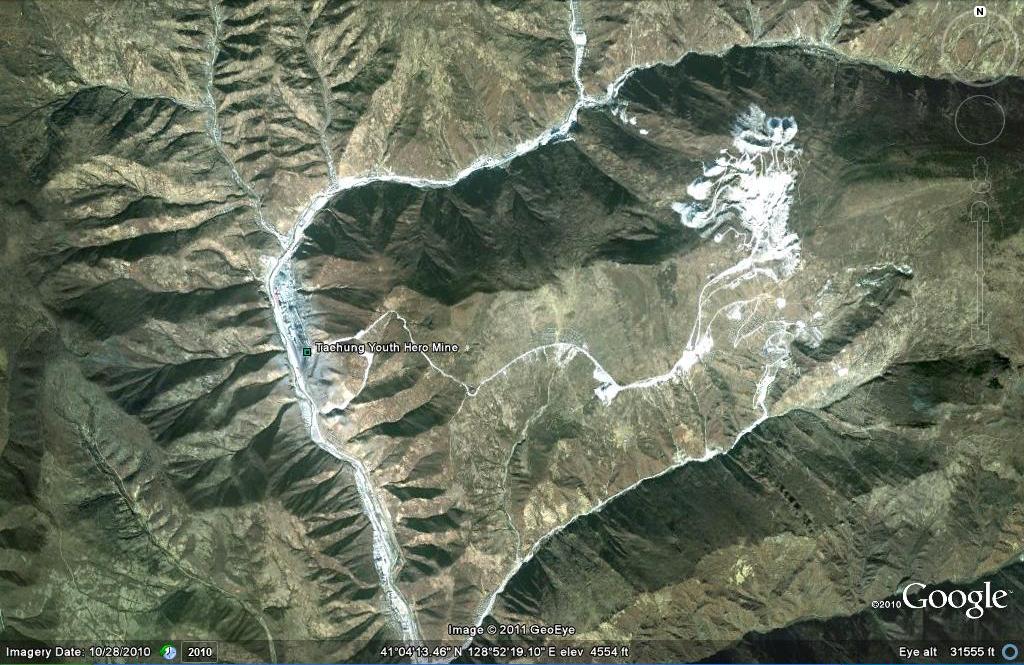
Taehung (Daeheung) Mine (대흥청년영웅광산)
41° 4’24.63″N, 128°51’4.68″E
Taehung-dong, Tancheon City, South Hamgyong

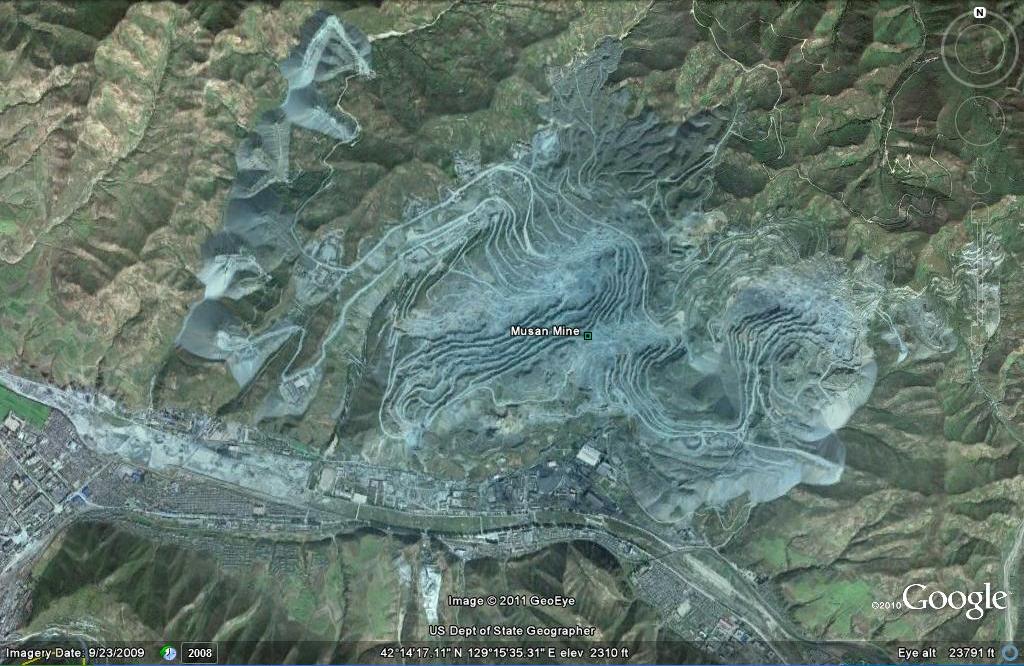
Musan Mine Complex (무산광산련합기업소)
42°14’16.22″N, 129°15’59.70″E
Musan, North Hamgyong

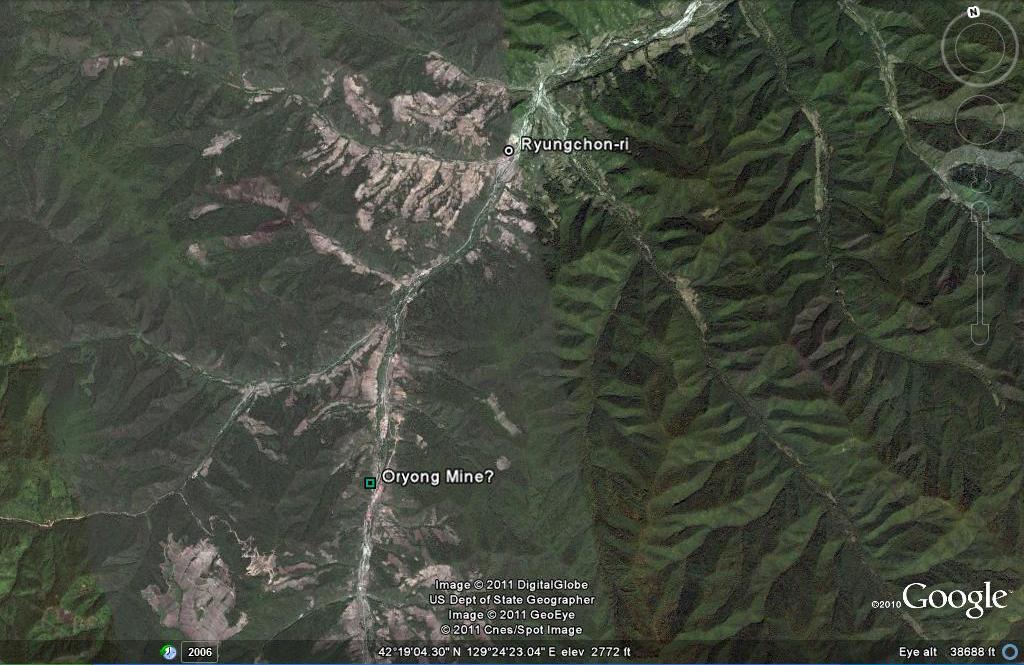
Oryong Mine (어룡광산?)
42°18’13.59″N, 129°22’51.70″E (estimated)
According to the paper, the Oryong Mine is near Ryungchon-ri (42°20’18.19″N, 129°24’39.48″E) in Hoeryong and opened in 2007. The satellite imagery of the area is from 2006 and shows an area under construction near the village. Another source claims this mine is located in Obong-dong, closer to the city of Hoeryong and is a uranium mine.

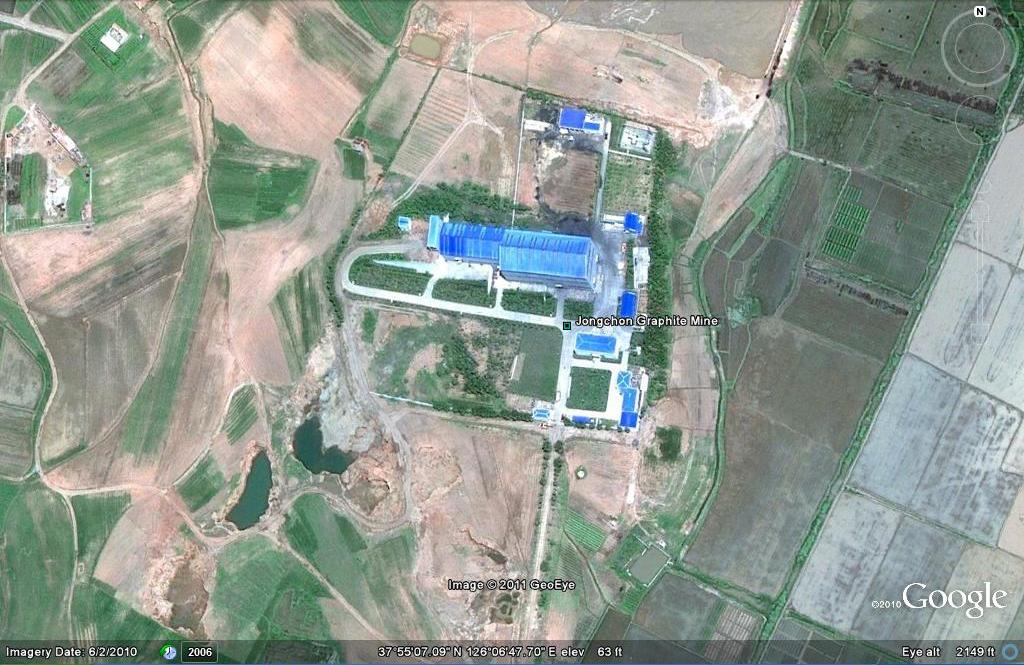
Jongchon Graphite Mine (정촌광산)
37°55’7.23″N, 126° 6’49.34″E
Jongchon-ri, Yonan County, South Hwanghae.  The paper claims the mine is located in “Jeongchon-gun”, which does not exist.

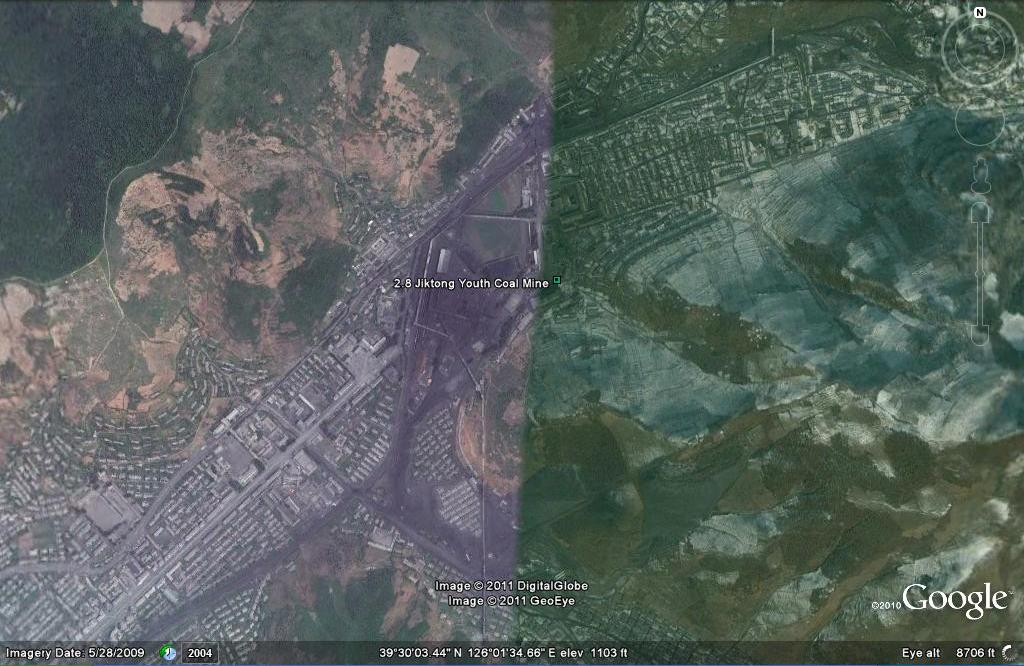
2.8 Jiktong Youth Coal Mine (2.8직동 청년 탄광)
39°29’42.68″N, 126° 2’3.50″E
Jiktong, Sunchon, South Pyongan

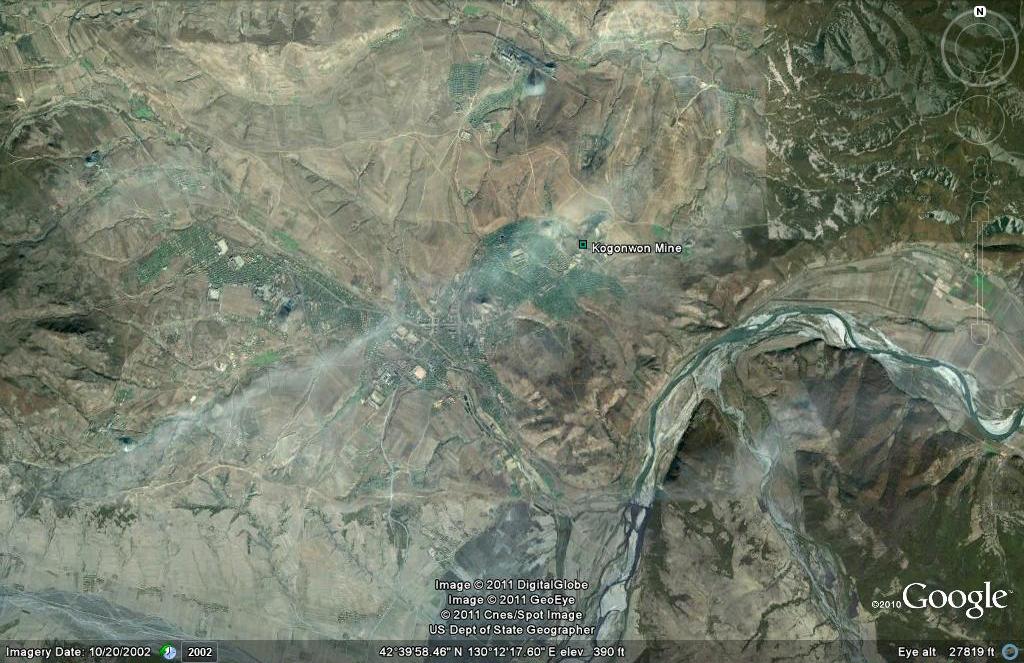
Kogonwon (Gogeonwon) Mine (고건원탄광)
42°40’25.03″N, 130°12’47.28″E
Kogonwon Worker’s District, Saepyol County, North Hamgyong Province

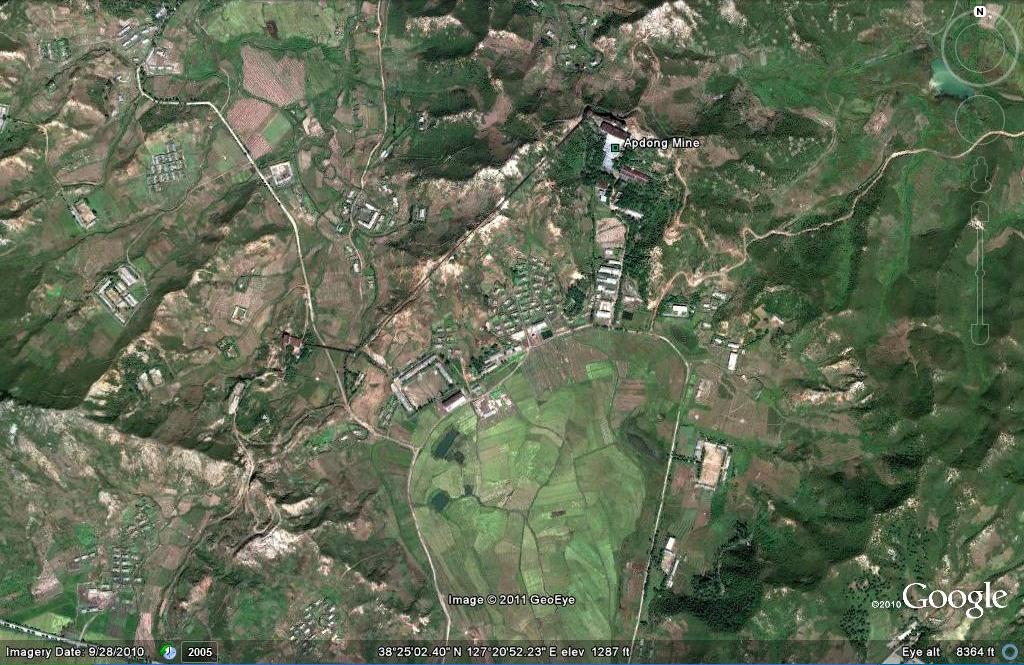
Apdong Mine (압동광산)
38°25’6.96″N, 127°21’8.17″E
Apdong-ri, Phyonggang County, Kangwon Province

Share